A 100mph fastball is not magic. It is energy transformed through a body, a task, and an environment that must be set up before the ball ever leaves the hand.
A 100mph fastball is beautiful. The hiss of the ball in the air, the boom when it hits the catcher’s glove, and the simple beauty of a throwing action that refined. It is a sight to behold.
It is also 144 Joules of kinetic energy. That energy was not created by the pitcher. It was transformed. Chemical energy became mechanical energy became kinetic energy in a baseball. Understanding how that transformation works is the foundation of everything that follows in player development.
MLB teams are spending millions of dollars annually to develop or acquire that single action. Companies like Driveline, Kinatrax, Theia, Trackman, and Rapsodo have completely changed the player development landscape. The MLB has even intervened to prevent excessive spending by organizations.
AI is coming next. In 5 years or less, player programming will be predicated on motion capture, force plate, and other proprietary data. Coaches will no longer be putting together individualized plans. They will be working with players in real time, making adjustments, altering constraints, and creating environments for the player to learn. The tools are changing daily. The physics they are built on will not.
This article is about thermodynamics and its fundamentals, and how we can improve our understanding of player development based on basic physics.
Physics and Math
Like many of you the last time I took a chemistry or college course was in College. So we will be starting with the basics.
Energy cannot be created or destroyed, simply transformed from one form to another. — The First Law of Thermodynamics
That single fundamental truth tells us more about a baseball throw than any other blog you will read, podcast you will listen to, or video you will watch. A 100mph fastball is not created. The thrower does not create energy, it is merely transformed within the body and transferred to the ball. The thrower acts as a conduit for energy flow.
A simple knee jerk reaction to this statement is that throwers do create energy through muscular contractions. That is incorrect. Throwers create muscular energy by transforming chemical potential energy, into mechanical muscular contractions through actin and myosin cross bridge cycling. This is categorized as energy transformation because Adenosine Triphosphate (ATP) donates a high energy phosphate during muscular contraction. We do not create energy, merely harness it. Energy is important because it is the ultimate determinant of ball velocity.
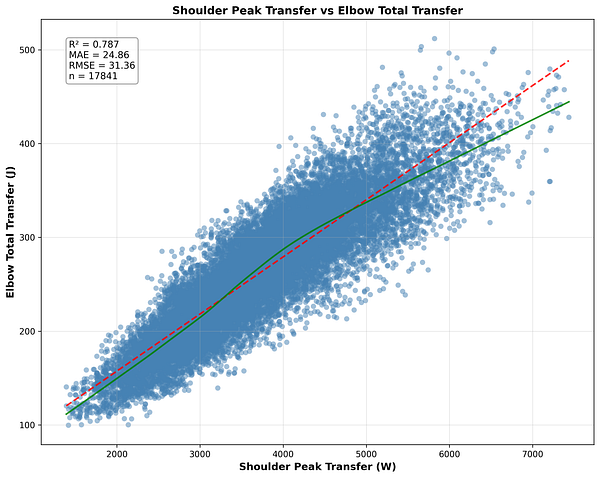
“Pitch velocity is strongly associated with the magnitude of energy transfer through the arm (shoulder and elbow transfer peaks and totals), not with the generation/absorption of energy or the timing of peak power” — Adam Bloebaum
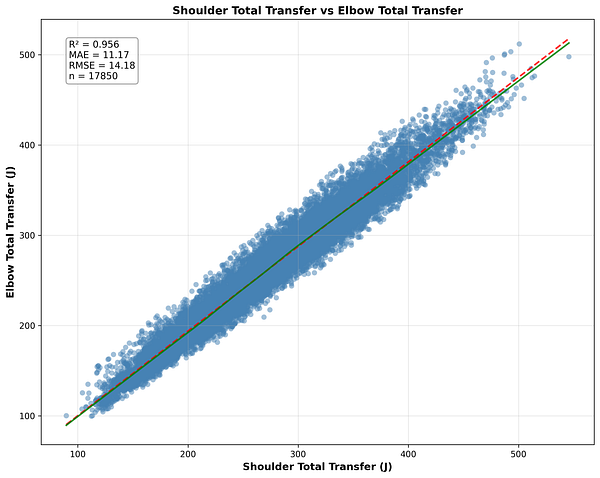
How does energy transfer create ball velocity?
K = 12 m v2
Kinetic Energy (K) is the energy an object has due to its motion, and its unit is Joules. This equation tells us how much energy, in Joules, needs to be transferred to the ball to make it move 100mph. Given we know a ball’s weight and ideal velocity, we can solve for the amount of energy we need to transfer to the ball:
K = 12 (.145 kg) · (44.704 ms)2
The weight (5oz or .145 kilograms) and the velocity (100mph or 44.7 meters/seconds) of the ball is known. Therefore, to throw a baseball 100mph we need to transfer 144 Joules into the baseball. What the hell does that even mean? Energy needs to be transferred over time. Joules, can be converted into a familiar term: Watts. A singular Watt is equivalent to 1 Joules per second. An ability to convert Joules into Watts is the reason that energy flow graphs typically have Watts as the Y-axis on many biomechanics’ graphics.
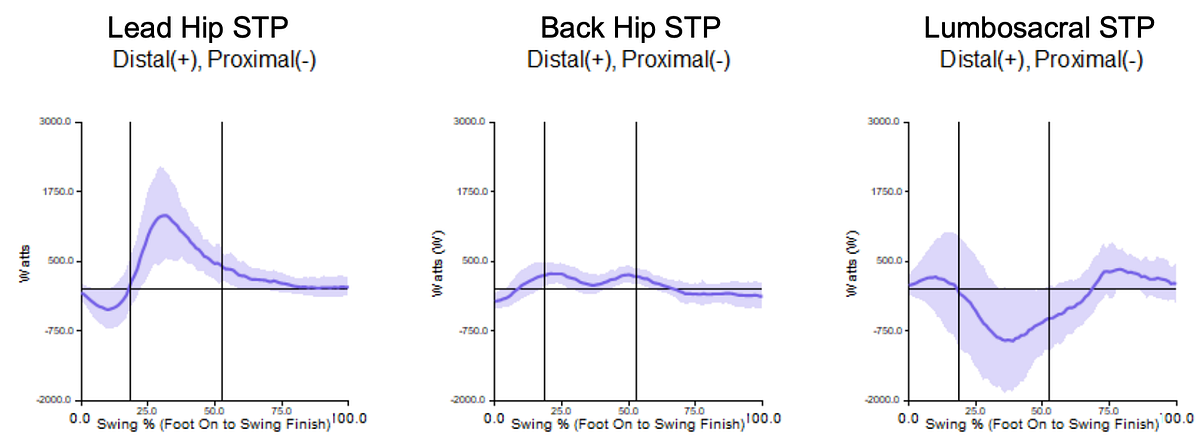
The distance between the bright purple line and the x-axis at any point is the number of Watts being transferred at that singular point in time. For every point on that line, we want to find the distance between the line itself and the x-axis. If we know the distance at every point at infinitely small-time intervals, then we know the area under that curve.
This area is energy transfer. Power is simply the energy generated at an arbitrary point in time. Energy is the summation of power between the two events of interest. This can be written as an equation.
E = t1 ∫ t0 P(t) dt
Because of the work we have done before, this equation can be simplified with some information that we already know. We know it takes 142 Joules to throw the ball 100mph.
Etransfer = BR ∫ FFS Pball(t) dt ≈ 142 J
Another thing that we know is that the majority — if not all — of this energy is transferred to the ball between front-foot strike and ball release. These two events create the throw. Everything before front foot strike is designed to put the body in a position to transfer 144 Joules of energy to the ball between these two events. Typically, at front foot strike, the ball has yet to accelerate towards the target. It becomes our lower bound (first event of interest) because we want to constrain our energy transfer to only the areas we care about. Obviously, after the ball is in the air, the thrower is no longer transferring energy into the ball. Ball release becomes our upper bound (second event of interest).
Energy
Organisms continuously use energy to fight against decay. Without energy, creating life would be impossible because organisms wouldn’t move, live, survive, or populate. Energy allows organisms to fight against entropy. Entropy is simply the universe’s tendency toward decay and disorder.
The total entropy of an isolated system always increases over time. — The Second Law of Thermodynamics
This law tells us something important about throwing, perfect energy transfer does not exist. Some energy will always be lost during transfer or transformation, typically as heat. Even when energy transfers from the fingers into the ball, friction bleeds off thermal energy. Heat is the unavoidable tax on every muscular contraction, every segment rotation, every moment of ball-hand contact. Because thermal energy is non-useful for throwing, it increases the entropy of the universe. We are directly contributing to our ultimate decay.
Organisms are open systems; they freely exchange both energy and matter with their environment. Humans eat sandwiches and throw 100mph fastballs. The connection between those two facts is direct: metabolic processes break down food into waste and chemical energy stored as ATP. That chemical energy transforms into mechanical energy through muscular contraction, then transfers into the baseball as kinetic energy. At every step, some energy bleeds off as heat and that energy that cannot be recaptured. This continuous exchange with the environment is what makes self-sustaining life possible.
Potential Energy
The energy that we transfer to the ball has to come from somewhere. The typical answer is angular velocity, muscular contractions, or the ground. That doesn’t encapsulate the complete interaction. It comes from Potential Energy. There are a few different categories of potential energy that are relevant.
Chemical Potential Energy
Chemical potential energy is the energy that can potentially be used to interact with the environment. This potential energy arises from molecular structure (Moebs et al., 2016). Humans store chemical energy in glycogen, fat, and creatine phosphate. These are the warehouses. When the body needs to act, metabolic processes convert those stores into Adenosine Triphosphate (ATP).
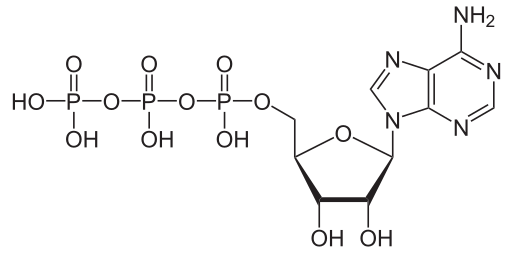
ATP is not a storage molecule. The body only maintains about 80–100 grams of it at any given time, enough for a few seconds of maximal effort. ATP is the currency. It is the bridge between stored chemical energy and mechanical work. Without metabolic processes converting stored energy into ATP, we would not be able to interact with the environment.
Why do we need stores at all? Because organisms cannot predict when they will next acquire energy from the environment, or what demands the environment will place on them. Storage is the solution to uncertainty. An organism’s consumption of food is entirely driven to build these reserves and fight against decay. Without food consumption and subsequent energy storage the organism will decay.
This storage must be large enough to meet demands that we cannot fully predict.
“The motion of the whole is the sum of its parts” — Isaac Newton.
In sport, “the motion of the whole is not only greater than, but different than the sum of the motions of the parts, due to nonlinear interactions among the parts and between the parts and the environment” (Kelso, 1995). The demands of throwing are not fixed. They emerge from the interaction between the task, the environment, and the organism in real time.
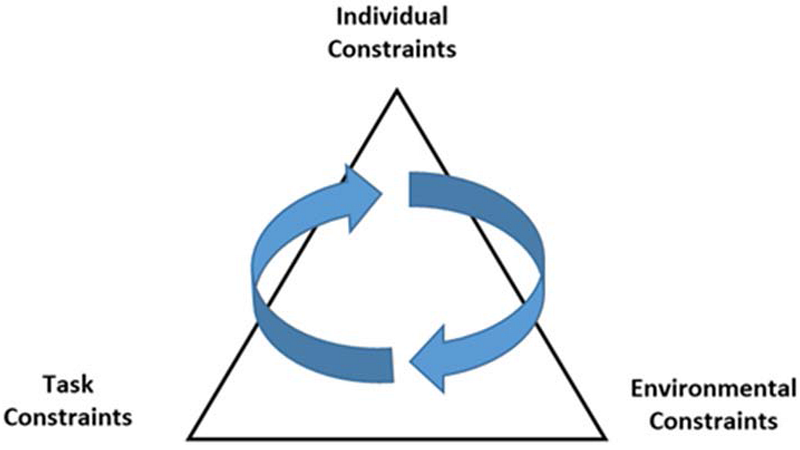
A pitch with a runner on third in the ninth inning is not the same energetic event as a pitch in the second inning with bases empty, even if the radar gun reads the same number. Potential energy reserves must meet demands the body cannot fully anticipate.
We need large chemical energy stores because the demands are nonlinear and unpredictable. Storage solves the prediction problem. ATP conversion solves the access problem. Without sufficient stores and the metabolic machinery to convert them, the organism cannot meet the demands of the environment. It fails.
Gravitational Potential Energy
There is a significant amount of gravitational potential energy present in the throwing motion, and it comes from two places.

The first is the mound. A major league mound is 10 inches in height. We are throwing “down” the mound. A 190 pound pitcher standing that mound with a COM 211 Joules of gravitational PE relative to the plate. If we elevate his center of mass another 45 inches (to the same height that it is at first move) the pitcher has access to 1166 J of potential energy. Recall that a 100mph fastball requires 144 Joules of kinetic energy. The mound stores more energy than the ball needs. The body cannot transfer all of it cleanly, muscles and tendons absorb a significant portion as heat, but the scale matters. Even at first move we still have a significant amount of potential energy available.
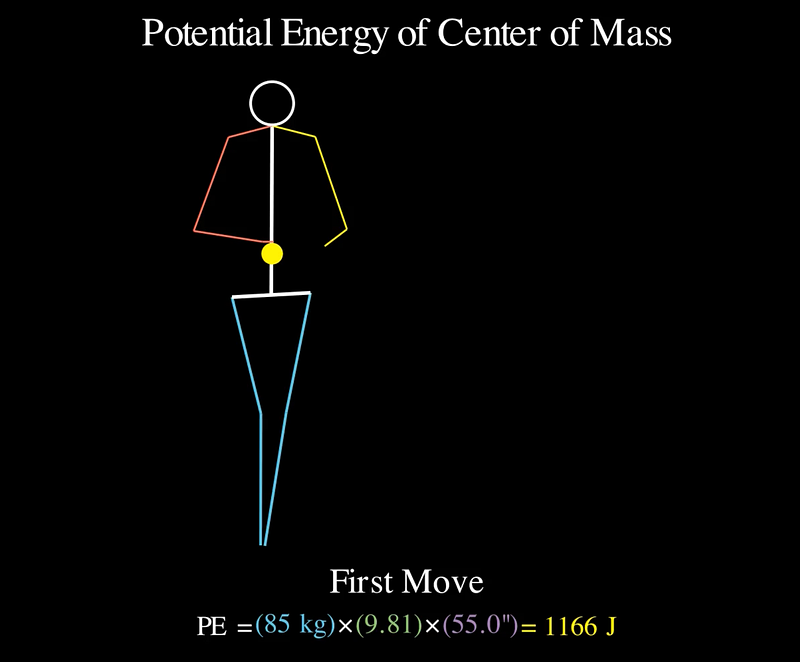
The second is the leg lift. The leg lift physically lifts the body’s center of mass by raising one leg. Nolan Ryan famously talked about raising his leg more when he wanted to throw harder. A higher leg lift elevates the center of mass, and gives the body more distance and time to accelerate during the stride. When the center of mass is the highest, we have the most gravitational potential energy at our disposal.
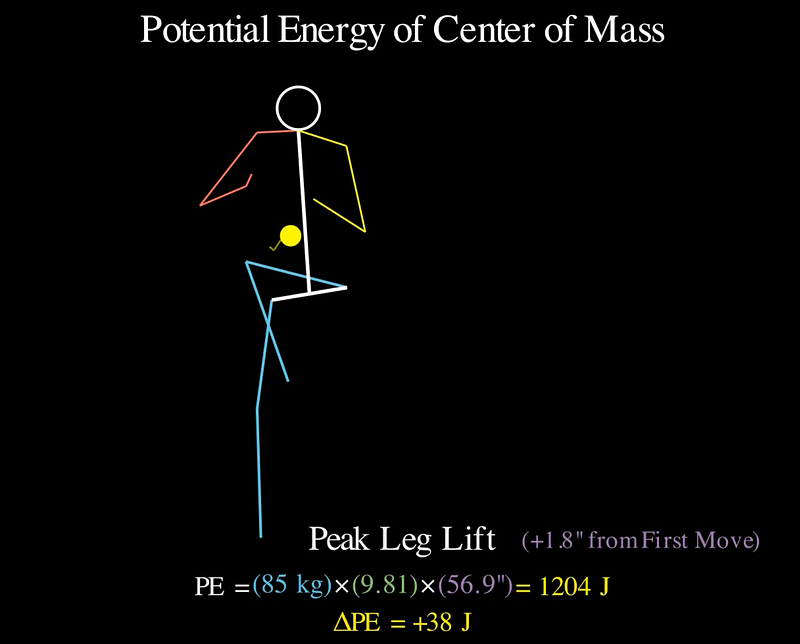
So what is gravitational potential energy? The equation is:
PE = mgh
Gravity fields have energy, as is demonstrated by the rotation of the moon around earth, and the earth around the sun. On earth, the higher an object is raised, the more gravitational potential energy it has. When lifting an object, we are using our chemical potential energy, transforming it into mechanical energy, and doing work on the object to resist gravity. We are storing that object with potential energy. When we drop it, gravity accelerates it downward at 9.81 m/s². That object will accelerate until it hits the ground or reaches terminal velocity. The same principle applies to a ball in flight. The ball has the most gravitational potential energy at the apex of its arc.
During the throw, the pitcher’s center of mass descends rapidly as the body moves forward and downhill. Gravitational PE converts into kinetic energy.
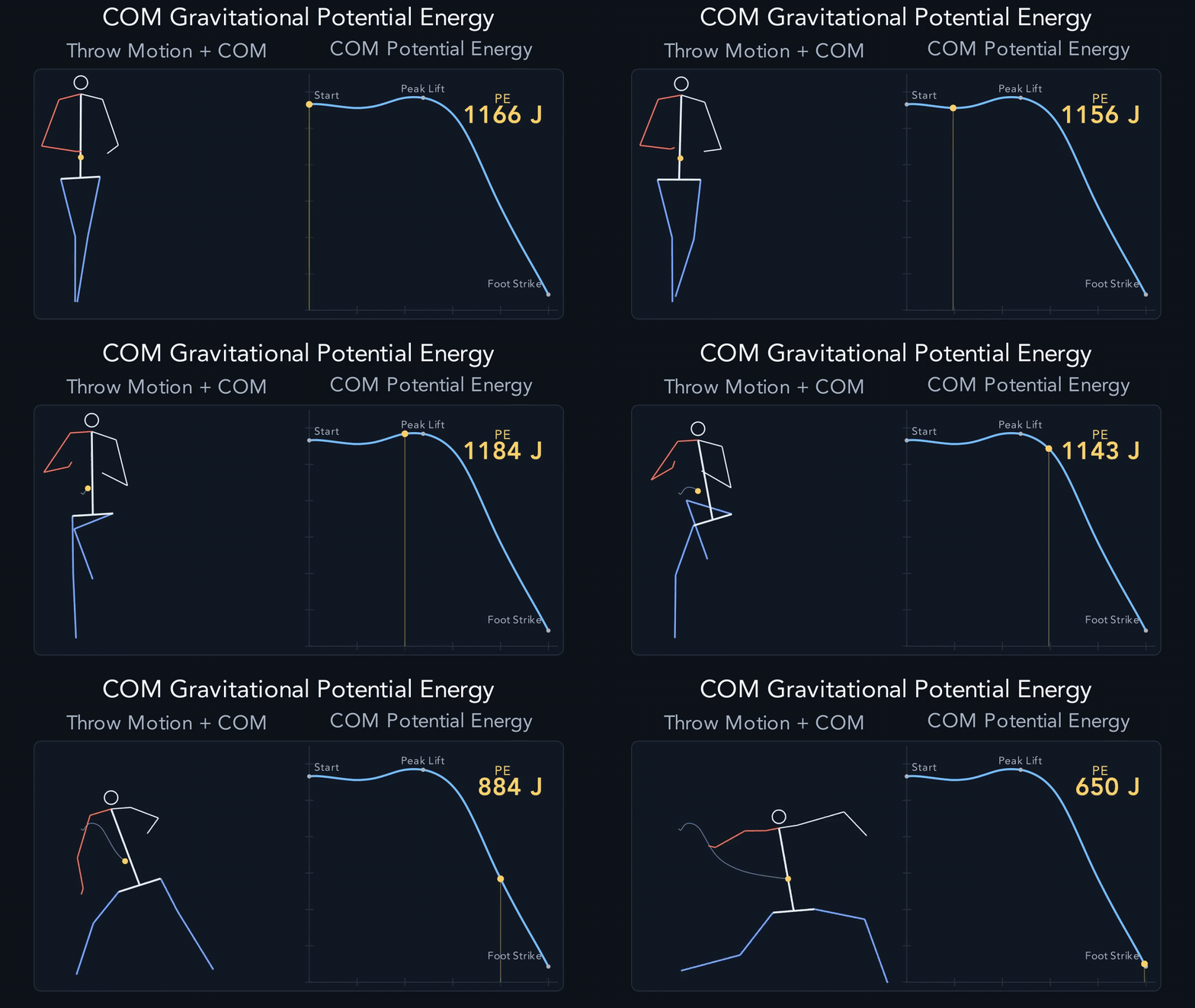
Complete animation of a throw from the Open Biomechanics Project where the potential energy of the COM is calculated at 3 distinct events.
When the lead foot strikes the ground, that kinetic energy produces large ground reaction forces. Those forces drive trunk rotation and the sequential energy transfer that powers the entire throw. This transformation from potential to kinetic energy, that is then transferred to the ball, is fundamental to throwing.
Elastic Potential Energy
Muscles, tendons, and fascia store elastic energy when they are stretched under load. This is the same principle as pulling back a rubber band. Stretch the tissue, and it wants to snap back. Shorten it excessively, and it wants to spring back into place. This cyclic action between stretching and shortening is omnipresent in the body, and we actively manipulate it to create stronger and more powerful movements. The primary mechanism for this is the stretch shortening cycle.
The stretch shortening cycle works in two phases. First, an eccentric contraction stretches the muscle-tendon unit and stores elastic energy. Then, immediately, a concentric contraction releases that stored energy. The speed of the transition matters. The faster the switch from stretch to shortening, the more elastic energy is recovered. This is why a countermovement jump, where you squat down before jumping, produces more force than a squat jump from a dead stop. The countermovement stretches the hip and knee extensors in the posterior chain, storing elastic energy that adds to the concentric phase. That stored energy contributes force beyond what muscular contraction alone can produce.
Energy is stored inside of tissues so it can be released later, advantageously. Before ball release, the entire anterior chain is stretched. At maximum external rotation, the shoulder external rotators, the pec, and the anterior trunk musculature are all eccentrically loaded. A large amount of elastic potential energy is created at this position. This stored energy is transformed into kinetic energy as the trunk and arm accelerate forward into ball release. The elastic contribution at this phase of the throw is significant. It is arguably the largest energy source for ball velocity in the entire delivery.
This process is not perfectly efficient. Tendons and collagen are viscoelastic, not purely elastic. When a viscoelastic material is loaded and unloaded, the unloading curve is different from the loading curve. The difference between the two curves represents the amount of energy that is dissipated or lost during loading (Kelc et al., 2013).
![[Hysteresis or energy dissipation — when tendon or ligament is loaded and unloaded, the unloading curve will not follow the loading curve. The energy is lost as heat (dashed area)]. Source: Kelc et al. (2013), Figure 8. https://doi.org/10.5772/54234.](../../../assets/images/articles/thermodynamics/hysteresis-energy-dissipation.png)
Some of that stored elastic energy bleeds off as heat before it can be used. This is consistent with the second law of thermodynamics. No energy transfer is truly efficient. We are always contributing to disorder.
Energy Gradients
Energy flows. It is always dissipating. High energy states degrade into low energy states given enough time. When you have a big rock at the top of a hill and give it a push, it rolls downhill. It does not roll sideways. It does not hover. It rolls down. That release of stored potential energy along a predictable path is an energy gradient.
The same principle governs human movement. When you squat down into a deep squat rapidly, where is your next movement going to be? Up. The system has been loaded with potential energy, and that energy is only going to dissipate in certain directions. You have constrained the future by setting up the present.
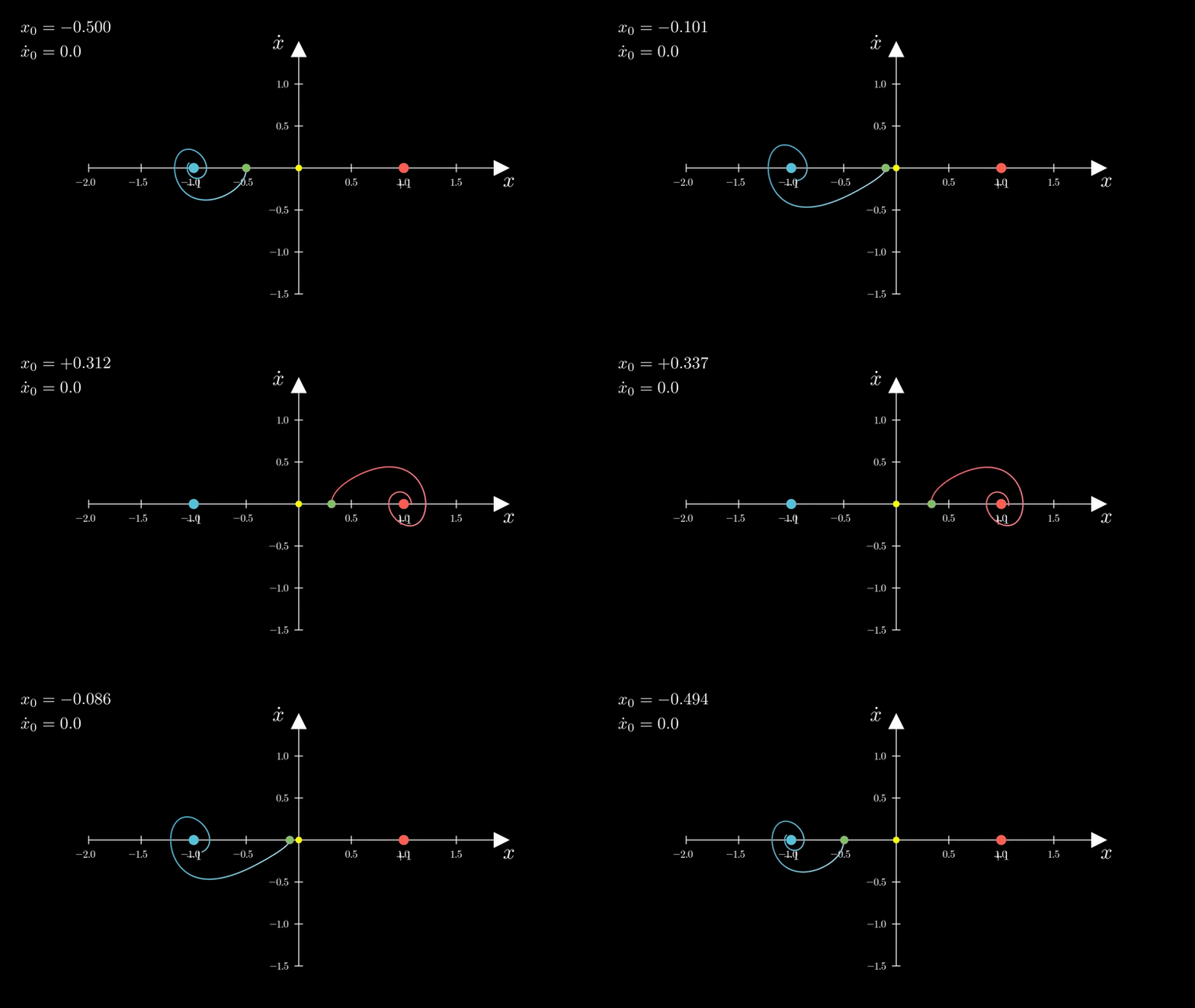
This brings us to a concept from dynamical systems theory: initial conditions. How you set up a system dictates how the system moves in the future. Varying the initial conditions varies the resulting movement. In throwing, the combination of gravitational, chemical, and elastic potential energy at positions like peak leg lift are the initial conditions of the throw. They are the dominoes being set up. How you set them up determines the only pattern they can fall in.
At peak leg lift, gravitational PE is maximized. The body is loaded on the back leg with elastic energy building in the hip and trunk. Chemical energy is being converted into ATP to fuel the contractions that will control the entire sequence. All three energy systems are loaded simultaneously. From that position, everything flows downhill. The center of mass descends, converting gravitational PE into kinetic energy. The stride lengthens the anterior chain, storing elastic energy that will release explosively into ball release. Ground reaction forces at foot strike redirect the body’s kinetic energy into trunk rotation.
The throw is an energy gradient. The pitcher spends the entire windup and stride building potential energy, and then that energy can only dissipate in one specific pattern. How you harness potential energy early in the delivery will dictate how you transfer energy later. The resultant energy transfer is the most important determinant of ball velocity. Obviously, hitting has some similar traits.
Organisms have to use energy to get into these high energy states in the first place. Left to our own devices, we would succumb to entropy. The input of energy is what drives the mechanical output. You spend all your time setting up the dominoes. Then they fall.
What This Means for Coaches
If resulting movements are the product of initial conditions, then coaching is fundamentally about setting up initial conditions.
This has direct implications for how coaches practicing a constraints-led approach should be working with players. How you set up the practice and the player will determine their eventual actions. If the resulting movement is a product of the initial conditions, then any movement inaccuracy or process flaw is a task design failure. That is a strong claim, and I am making it deliberately. The player is responding to the constraints you gave them. If the output is wrong, the setup was wrong.
There is also a growing movement toward altering initial conditions to increase movement efficiency. Simple changes, like starting with the ball in a different position, or putting the body in a different preset posture, will have far reaching ramifications in later movements. Small changes to initial conditions create large changes downstream. This is a property of dynamical systems, not a coaching trick.
Alex Sarama uses this principle with differential shooting by feeding the ball differently to players. The variability in how the ball is caught creates variability in the initial conditions of the shot. That variability naturally irons out inefficient movement patterns over time without the coach needing to give a single technical cue. The constraints do the coaching.
This is the practical application of everything in this article. Energy cannot be created or destroyed, only transformed. The pitcher stores potential energy, chemical, gravitational, and elastic, and transforms it into 142 Joules of kinetic energy in a baseball. The positions the body passes through determine how much energy is available and how it flows. Coaches who understand this are not coaching movements. They are coaching energy states. They are setting up dominoes.
The tools are changing. Motion capture, force plates, and biomechanics software are giving us better ways to measure these energy states. But the underlying physics will not change. The coaches who understand the fundamentals will be the ones who survive the technological revolution. The rest will be replaced.
Practical Takeaways
- Coach the initial conditions that shape the throw before chasing the final movement alone.
- Understand velocity as transformed energy, not as an isolated mechanical cue.
- Use constraints to set up useful energy gradients that the athlete can solve in real time.
- Technology changes quickly; the underlying physics of the task does not.